
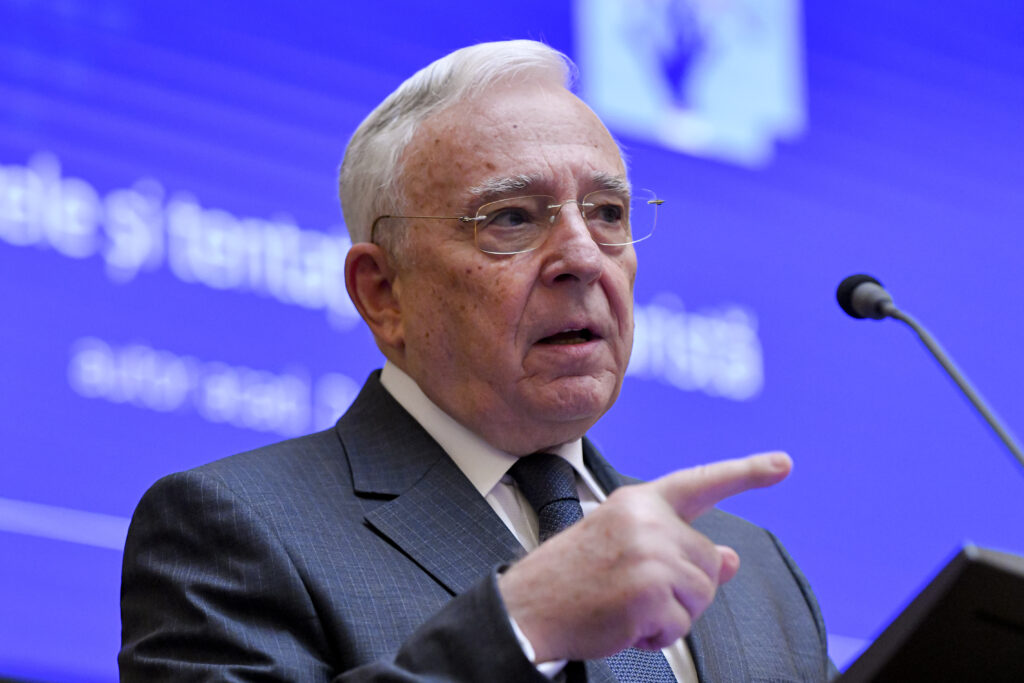
The Governor of the National Bank of Romania, Mugur Isărescu, declared on Thursday, during a press conference, that Romania has no alternative to the transition to the euro, but the country is not ready at this time for this step. According to the BNR Governor, Romania must first reduce its budget deficit below 3% and maintain this fiscal correction.
He said that the National Bank has supported Romanias preparation for the adoption of the euro in the past. It is very good. The National Bank has also supported in the past, including through a real secretariat for the transition to the euro.
Until 2018, here, in this room, the meetings of the Euro Changeover Committee were held. I have said it several times. We then reached, in the 2011-2012 discussions, we also reached the detail of where to enter the cash machines in the country and which branches should have sufficient or large deposits and where to post, so to speak, to place the cash stock.
So it was interrupted in 2018, when, practically, other priorities became the priorities, explained the NBR governor. Romania also met the criteria in 2014 Mugur Isărescu said that Romania had a moment in the past when it met the criteria for adopting the euro. He talked about 2014, when the budget deficit was reduced, including through measures to which the First Deputy Governor of the National Bank of Romania, Florin Georgescu, who was then Minister of Finance, contributed.
President Băsescu also had the 2014 project, but the context, I remind you and I remind everyone, is that if we are really talking about meeting the criteria, then the criteria were met. And we contributed to that. The First Deputy Governor of the National Bank, Mr.
Florin Georgescu, was exported, so in quotation marks, he became Deputy Prime Minister and Minister of Finance. He contributed to those budget deficit reductions in 2014. But in 2013-2014, the external context was not favorable.
The Greek crisis, the eurozone crisis. That was the period when there was even talk of the dismemberment of the area, the disappearance of the eurozone. So there was no discussion then of a new country entering the eurozone, said Mugur Isărescu.
He said that, after 2014, Romania entered a period in which taxes were reduced and expenses increased. This led to the deficit increasing again. Later, the COVID-19 pandemic and the war in Ukraine changed economic priorities.
“And since 2015, a race began to reduce more… VAT was also reduced. There was even a formulation to give back to Romanians the money that Băsescu took by increasing VAT here. It was a race to reduce taxes more and increase spending more.
And we ended up with a large deficit again. And then the pandemic, the war intervened and other priorities were created,” said Isărescu. BNR is ready to resume preparations Mugur Isărescu said that the BNR is ready to resume the preparation activity for the transition to the euro, noting, however, that “it is a complicated political process.
” Not only do we continue to support. We are ready to pull out of the mothballs, so to speak, the entire organizational structure of the secretariat. But the transition to the euro is not an easy currency exchange.
Lets exchange the leu for a currency. No, it is a complicated political process. It has both political and social components.
It goes all the way to the whole of society. And we cannot do it alone. We have an important role, lets say, but the Government, the Parliament, they will decide this.
We can contribute to the correct formulation of a path, explained the BNR governor. There is one more thing, so that there is no confusion, we have no other alternative. So the moment we signed the accession treaty it is a given that we will switch to the euro when the conditions are necessary.
When we meet the conditions. We do not have the status that, for example, England or Denmark had to keep our national currency. So the decision is already made.
A discussion is to see. It may be when to do it, when to start the discussions. We are ready to do it when society is ready, Mugur Isărescu also said.
We do not have any criteria met at the moment Asked if Romania is currently ready to adopt the euro, the BNR governor replied that we do not have any criteria met at the moment. At the moment, the country is not met. The priority, says Isărescu, is to reduce the deficit and maintain fiscal correction, so that Romania can later enter the exchange rate mechanism.
The priority, says Isărescu, is to reduce the deficit and maintain the fiscal correction, so that Romania can later enter the exchange rate mechanism. “Now you ask me if the country is ready. We do not have any criteria met at the moment.
At the moment, the country is not met. And the priority is to make this fiscal correction, to resist, to keep it. Because the experience of 2014 shows us that if we do not keep it, we cannot even enter the exchange rate mechanism,” the governor said.
When will Romania switch to the euro Asked how long it could realistically take until Romania adopts the euro, Mugur Isărescu said that “I cannot say now”. He specified that the first objective is for the budget deficit to fall below the 3% threshold. I cant say now.
We must first get the deficit below 3%, because everything will come from there. And the extreme deficit, in my opinion, some say that it also depends on competitiveness. We are still judging, said Mugur Isărescu.
The BNR Governor also stated that reducing the fiscal deficit would also have effects on the external deficit and on inflation. But from the external deficit, from the fiscal deficit, the external deficit also comes, and inflation, part of the inflation, that you dont have a deficit of 9%, but you cant say that it is easy for you to fight inflation only with monetary policy and, in addition, which is very important, a remarkable legislative instability in the fiscal field. Then, in 2014, when it was said that we were entering the euro area, the VAT was reduced the very next year, Mugur Isărescu also said.